

On Feb 28, U.S.–Israel military strikes on Iran reportedly resulted in the death of Supreme Leader Khamenei. Iran retaliated with missiles and drones, and closed the Strait of Hormuz, sending energy route risks soaring and pushing capital markets into high volatility.
Three core factors drove the strike.
A reshaping of regional power: Washington aims to degrade Iran’s nuclear program, missile capabilities, and proxy network.
Competition for control over energy and maritime routes: Iran holds the world’s third‑largest oil reserves and second‑largest natural gas reserves, and dominates the northern shore of the Strait of Hormuz.
Domestic political dynamics: U.S. election‑year pressures have strengthened the incentive for a more assertive foreign‑policy posture.
Safe-haven and energy risk premia were rapidly priced into global markets. Spot gold hit $5,393.41/oz, silver $96.39/oz; Brent crude jumped over 13% to $82.37/bbl, with pricing focus shifting from demand to supply security and shipping sustainability.
ETO Markets has modeled future conflict scenarios, combining price action, cross-asset dynamics, and AI’s deep role in military decision-making.
AI Redefines Warfare: A “Painless” Targeted Strike
The strike on Khamenei marked a fundamental shift: AI moved from supporting intelligence analysis to embedding itself in every critical stage of the kill chain.
Khamenei had upgraded security after U.S. threats: unpredictable location changes, full-spectrum electromagnetic shielding, a 5km+ movement error margin. His only vulnerability was a three‑minute air‑defense blind spot during the dawn‑prayer security rotation.
Under traditional methods, such a strike would have been nearly impossible.
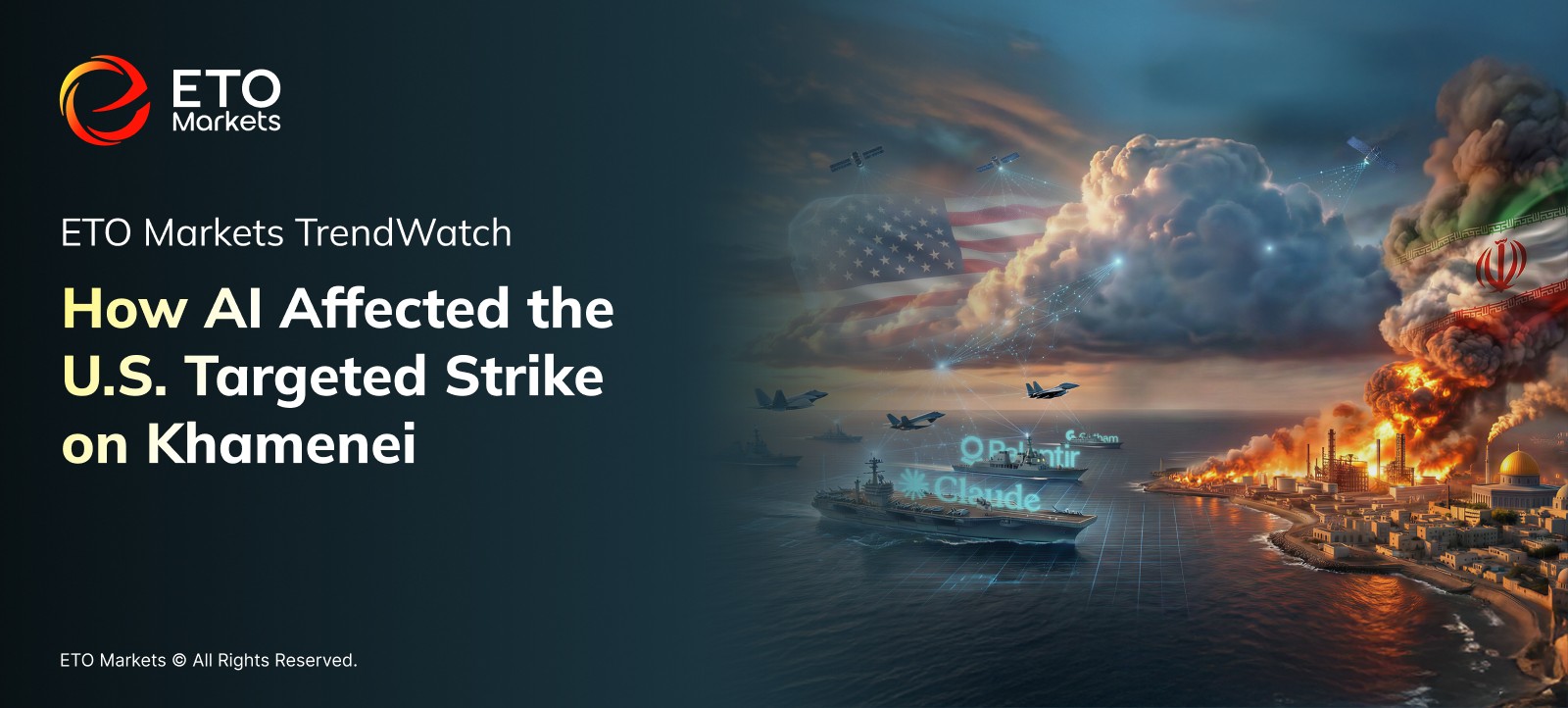
To overcome these constraints, two systems — Claude and Palantir — operated in a fully integrated combat mode.
Claude (Gov version), the only large model authorized to run on classified Pentagon networks, was deployed in a military‑customized Claude 4 Opus configuration and served as the mission’s intelligence and decision‑making core.
Leveraging Claude’s capabilities, U.S. forces:
Achieved 98.7% accuracy in Persian transcription and 82× faster encrypted‑file processing versus human analysts.
Ran time‑series models on six months of Khamenei’s movements, generating over 1,000 predictive paths and narrowing the strike window with 98.7% accuracy.
Conducted high‑precision blast‑radius simulations to optimize missile timing and altitude, reducing collateral damage to within 10 meters, enabling a “zero‑collateral” strike.
Palantir Gotham, the U.S. military’s core data‑fusion platform, handled operational execution.
Hundreds of satellites provided 24/7 continuous tracking of Khamenei’s movements.
Integrated battlefield geography, air‑defense data, and AI‑generated path simulations to identify an 800‑meter air‑defense blind zone, narrowing the target radius to 500 meters and isolating the three‑minute strike window.
Using Palantir’s AIP, Claude was embedded directly into Gotham, creating a seamless operational pipeline connected to U.S. Central Command workflows. Claude handled analysis and scenario modeling; Palantir handled data integration and command execution. Human involvement was limited to final authorization.
Three Market Scenarios: Diverging Paths for Assets
The trajectory of the U.S.–Iran conflict will shape global energy flows and market volatility. ETO Markets outlines three distinct scenarios:
Quick Resolution & Shipping Recovery
If hostilities remain confined to military targets and Iran’s energy infrastructure remains intact, the Strait of Hormuz could reopen quickly.
Oil and gold would retrace after an initial spike, global equities would rebound, and geopolitical risk premia would unwind rapidly.
Limited Conflict Lasting Several Weeks
If Iran retaliates and restricts passage through the Strait, even a 1 million bpd supply disruption could trigger panic buying.
Oil would trade in a high‑volatility band, gold would stay firm, global equities would face sharper swings, and supply‑chain disruptions would lift stagflation expectations, driving flows into defensive sectors.
Full‑Scale Regional War
A prolonged closure of the Strait and widespread damage to Middle Eastern energy infrastructure would fracture global oil supply chains, echoing the 1970s energy crisis.
Oil would likely break USD 100/bbl, inflation would surge, growth would stall, equities would undergo deep corrections, and safe‑haven assets would dominate allocations.
Institutional Views: Oil Could Break USD 100; OPEC+ Hikes Have Limited Impact
The sustainability of shipping through the Strait of Hormuz is now the single most important variable for global markets. Major institutions have raised their oil‑price forecasts:
J.P. Morgan: A full closure of the Strait could leave regional producers able to maintain output for no more than 25 days. Flows on Feb 28 fell to 4 million bpd, almost all Iranian crude — one‑quarter of typical volumes.
Citigroup: Raised its short‑term Brent forecast by USD 15 to USD 85/bbl, expecting prices to trade between USD 80–90/bbl amid infrastructure risks and shipping disruptions.
Rystad Energy: If the Strait remains disrupted for weeks or months, USD 100/bbl becomes a realistic scenario. OPEC+ supply increases would have limited impact because most incremental barrels must still transit the Strait.
Goldman Sachs: Estimates real‑time geopolitical risk premia at USD 18/bbl, consistent with a six‑week halt in tanker traffic. Diesel, jet fuel, and naphtha markets would face severe stress, given that 9% of global diesel and 18% of jet fuel flows through the Strait.
Wood Mackenzie: Even with Iranian cooperation, restoring tanker traffic could take weeks. Failure to reopen the Strait quickly would push oil above USD 100/bbl.
Overall, the decisive variable remains the sustainability of shipping through the Strait of Hormuz. Gold and crude have already priced in significant risk premia, while equity markets remain in a wait‑and‑see mode. If energy risks continue to spill over, global pricing frameworks will shift toward a stagflation narrative.
ETO Markets will continue to monitor the interaction between geopolitical developments, energy supply dynamics, and liquidity conditions to identify shifts in risk premia and key market inflection points.
Disclaimer
The information contained herein is for general reference only and does not constitute investment advice, a solicitation, or an offer to buy or sell any financial products.
ETO Markets does not guarantee the accuracy, completeness, or timeliness of the information and shall not be liable for any losses incurred from reliance on such content.